

In Falls Church, Virginia, just outside Washington, D.C., 76 percent of residents have a bachelors’ degree or more, and the poverty rate is just 3 percent.
But in Galax, Virginia, at the other end of the state, the picture is starkly different: Poverty there is at 22 percent—nearly double the national rate. Median incomes are half the median statewide, and a quarter of adults don’t work. One in six has no high school diploma.
Nationwide, according to the bipartisan Economic Innovation Group (EIG), about 83 million Americans live in prosperous places like Falls Church, while 51 million live in “distressed” communities like Galax.
As the architect of EIG’s Distressed Communities Index, Senior Fellow Kenan Fikri has spent the better part of the last decade discovering who is prospering in America—and where. The maldistribution of American opportunity, he warns, has led to stark divides, economically, socially and politically. On the other hand, he argues, understanding the geography of opportunity could help to heal these rifts.
This interview has been edited for length and clarity. Watch or listen to the full discussion on Spotify, YouTube or iTunes.
***
Anne Kim: Kenan, for almost the past decade, you have been the mastermind of a really remarkable data set, the Distressed Communities Index (DCI). And the headline number from this year’s report is that 51 million Americans live in a “distressed community.” That’s 15 percent of the US population. Can you define what that means?
Kenan Fikri: We define “distressed” in the DCI based on seven different complementary social and economic metrics. We look at the poverty rate, we look at income levels, we look at housing vacancy rates, educational attainment, job growth, the opening or closing of new business establishments, and business growth too. We put all that together to provide a summary statistic of economic well-being at the zip code level all across the United States. And then communities that rank in the bottom one-fifth of all zip codes nationally, we consider “distressed.”
Even though it’s a relative measure—20 percent of all zip codes will always be “distressed” by our definition—the gaps that it captures are absolute. Poverty rates in distressed communities are more than twice as high as they are nationwide. That means that
in a period of strong national economic growth, distressed communities are generally going to be losing jobs and suffering from net business closures. The condition of being economically distressed is one of being disconnected from the broader national story.
Anne Kim: One of the remarkable things about your work is how it shows just how unevenly opportunity is distributed in America. You have maps online that show where the distressed communities are, as well as maps that show where the communities that are prospering are located. Can you talk a little bit about the geographic distribution of the distressed communities?
Kenan Fikri: Economic opportunity is unevenly distributed across the country and it varies on all sorts of scales. It varies broadly regionally between the Northeast corridor or the West Coast and the Deep South or Appalachia. It varies within states, within counties, and then really neighborhood by neighborhood. That’s why we start at the zip code level to really see the scale at which most Americans live, work, go to school, consume.
And you do see the so-called “other side of the tracks” phenomenon where on really small geographic scales, you have wide divergences in economic well-being. Often these may follow municipal boundaries. We can look at cities in the Midwest and often sometimes all the zip codes that are part of the city will be economically distressed, but as soon as you leave that core municipality and enter more suburban jurisdictions, you’re at a totally different plane of national economic well-being. But that’s at the very local level.
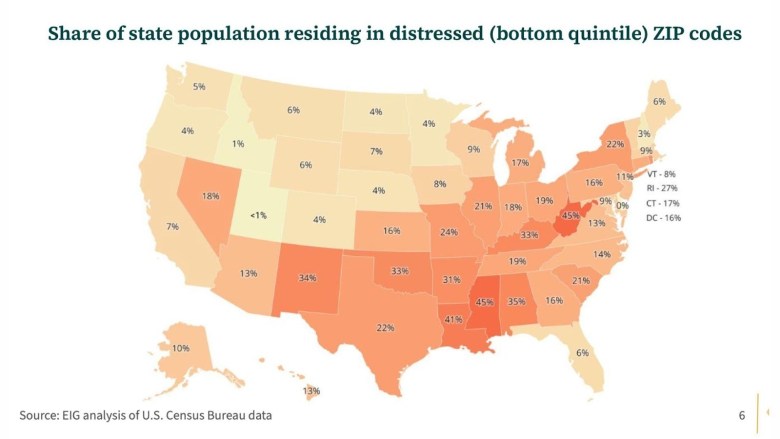
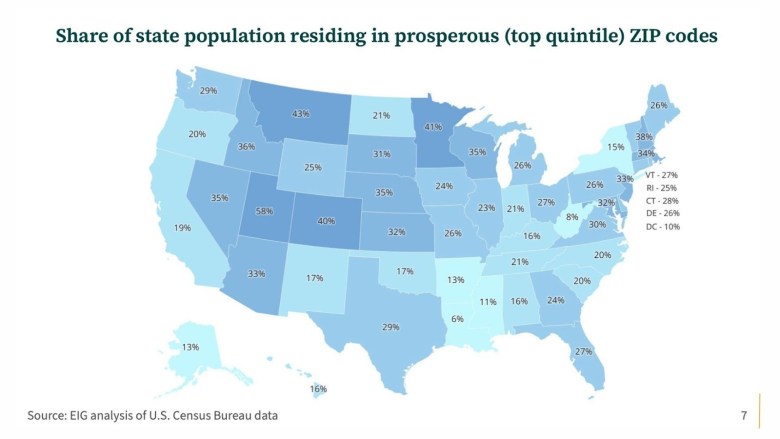
If you’re looking at the U.S. map, looking state by state, we see a concentration of distressed zip codes in the deep south, first and foremost, in states such as Louisiana and Mississippi, but then kind of stretching all the way up across the so-called “Eastern Heartland” into Ohio and Michigan where you’re still seeing above national percentages of state populations living in distressed communities. But really these pockets exist in really almost every major metropolitan area and then across numerous rural areas as well.
Anne Kim: You talked a little bit about the disparity in the poverty rate between the bottom quintile and the top quintile. But can you give more of a sense of how stark these disparities are?
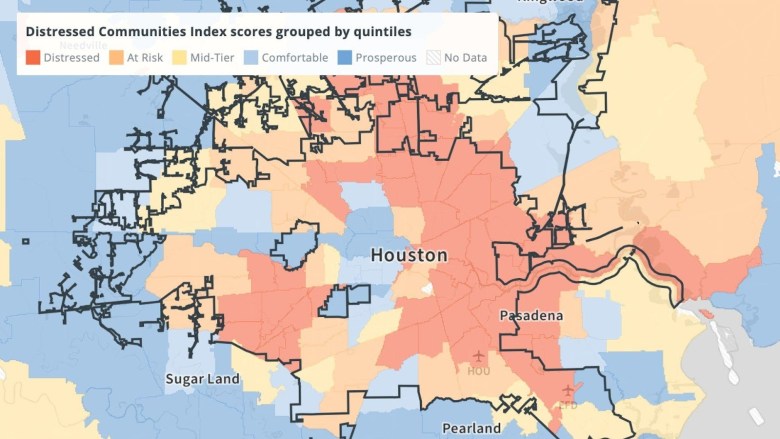
Kenan Fikri: Take Harris County, Texas, for example. It’s one of the most populous in the country, but 1.4 million residents live in a distressed zip code in the same county, while 1.1 million residents are living in a prosperous zip code. And here we’re talking about poverty rates that may be 30 percent or higher in the distressed portion of the community, compared to below 5 percent in some more outlying jurisdictions. You’re going to see huge gaps in educational attainment too. And even in something like vacancy rates where you have a lot of disinvested properties, you may have one in six, one in seven, one in five homes vacant in a distressed corner, even in a growth market such as Houston.
Anne Kim: One of the things that was really intriguing to me was the extent to which you found that in distressed communities, men are earning a lot less than women. And of course there’s stark racial inequality as well. Can you talk a little bit about the demographics?
Kenan Fikri: Place is really a vector in a frame to talk about people, zip codes and communities. I’m a geographer, and zip codes and counties are, you know, interesting units for a geographer because they it’s an organizing unit for social analysis as well as economic analysis.
Starting first with race and ethnicity before turning to gender, we see that generally in the United States, minorities are overrepresented in distressed communities and underrepresented in prosperous communities. That differs a little bit by subtype of race and ethnicity. Asian Americans are relatively better represented in prosperous communities. Hispanic Americans are generally clustered in the middle to lower tiers of communities on the DCI. And then African Americans and Native Americans are disproportionately concentrated in the distressed tier.
African Americans are about twice the share of the population in distressed communities as they are nationally. Place is a way to understand or reveal long running social conditions and afflictions in the United States today. And you can’t, when you’re looking at something like the DCI separate people from place from history. The economic conditions people experience are living history.
Anne Kim: On the gender piece, the disparity in men’s earning power versus women in some of these communities is really striking, especially when we have so many discussions politically about men and masculinity and Stolen Pride, to borrow the title of Arlie Russell Hochschild’s book.
Kenan Fikri: Absolutely. This was the first year we actually looked at gender through the lens of the DCI. We assumed, I guess naively, that there wouldn’t necessarily be that much variation across gender in the DCI, but we were really surprised to find that the earnings gap is wider in distressed communities.
In general, men’s economic conditions deteriorate much faster than women’s do as you go down the spectrum of community distress. Male educational attainment really lags behind, and there’s a sharp, sharp decline in college attainment rates as you move from the prosperous to the comfortable to mid-tier at risk and then to distressed quintiles.
Whereas women’s educational attainment is much more stable, regardless of community. There are still fewer women with college degrees in distressed communities than in prosperous ones, but it’s a much smoother gradient than it is for men. So I think it’s really an under-studied corner of social science right now—the vulnerability that men face with
limited economic conditions, and how that makes stabilizing a community harder as it filters through to family structures and things like that. It underscores the fact that this is a corner of discourse and understanding that we need to turn to as a country because whatever currents are underway in society today are running really deep, and they also run through space and communities.
Anne Kim: Does your research show any indication of why these gaps are happening? I’m assuming that in parts of the Rust Belt, for instance, it’s a story about the loss of manufacturing. But did you pick up any clues as to what was going on?
Kenan Fikri: It’s a great question and I wish we picked up greater clues. I think it does come down to economic opportunity in particular sectors. Men are likelier to find employment in traded sectors such as manufacturing and potentially white-collar work, versus traditionally non-traded or less traded sectors such as education, healthcare, social assistance and other professional services jobs that don’t vary as much by location and that women tend to be overrepresented in. So it’s either the elimination or loss of those traded sector jobs, or in some cases, like in rural areas, the fact that there never were that many strong jobs to begin with.
Anne Kim: And just to clarify, by “traded” sector, you mean a sector that’s susceptible to outsourcing?
Kenan Fikri: That’s economic geographer-speak, a traded sector is something that you sell beyond the region. So manufacturing would be traded. Consulting services could be a traded sector activity, or information services too. It’s really anything you’re selling to a wider market, be it nationally or globally, versus just the local community where people’s incomes circulate among things like doctors and grocery stores.
Anne Kim: What is the connection between levels of education and levels of distress? Do low levels of education cause a community to become distressed or is it the other way around? Which way does the causal connection run?
Kenan Fikri: It is really difficult to find a good job today without a more than a high school education. A lot of people who have found a good job with limited education may now be nearing the end of their careers, in industries where credentials didn’t matter as much as they do today.
It’s one of the first things that I point to to explain the geography of well-being today. Where college-educated Americans live is the well-off geography, whereas Americans with high school or less live in predominantly distressed geography. And then there are more mixed communities where folks with associates degrees or some college are interspersed with folks from both the high and low ends of the educational attainment spectrum living together. That’s where you’ll get mid-tier communities.
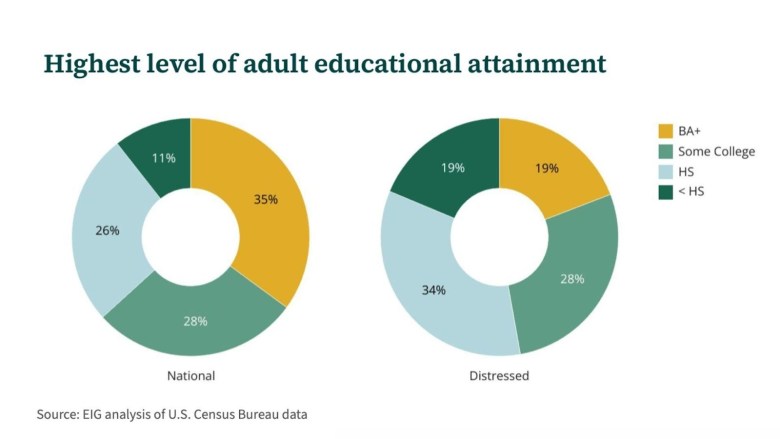
I don’t want to run to the conclusion that more education for everyone is automatically better because there are a lot of problems with the higher education system today, but the fact remains that that college degree is still the ticket to opportunity in the United States today.
Anne Kim: But the problem is, of course, that a lot of times when someone in a rural community, for instance, gets a college degree, they don’t necessarily stay in the community. That means they take their opportunities with them, or they chase the opportunity that exists elsewhere.
Kenan Fikri: True. Folks who are most likely to leave a community are the ones who are most likely to get higher education and find opportunity elsewhere. Mobility is lowest for the people who most need to get out to find new opportunity, but they’re often the ones who are most reluctant to move.
Anne Kim: I appreciate how the DCI defines well-being beyond simply financial security. One of the things that you found is that living in a distressed community has real costs for individuals. You find that on average people living in distressed communities can actually expect to die five years sooner than the counterparts in prosperous areas, which was yet another stunning and depressing finding. What accounts for that difference?
Kenan Fikri: It’s a great question. And even that five-year statistic is summarizing across all counties in the top and bottom quintiles. If you zoom in on specific locations like Virginia, you’ll see almost a 20-year gap in life expectancy between Arlington, Virginia, and Petersburg, a predominantly African-American city in southern Virginia.
These are absolutely shocking statistics that show why place matters to understand life outcomes. The DCI has become a way for researchers to study the social determinants of health because place corrals a whole bunch of unobservable factors into one unit. What do I mean by that? There are things like social connections, access to quality foods, access to quality healthcare, access to people and social groups and amenities and all sorts of wraparound services and culture that support good health that might be missing in a community.
It speaks to the toll—psychological and physical—that living in such an unequal country where inequalities are experienced so viscerally and so starkly can take on individual lives and livelihoods. When you fall through the pretty porous floor that the US economy puts underneath people and places, things can start to get pretty grim.
Anne Kim: I have to ask a little bit more of a fraught question now. When you look at the map of distressed communities versus prosperous ones, there is a huge similarity to the maps that show you red versus blue. The deep South, as you mentioned, is more distressed and it’s more red, and the coasts are a little bit more blue and they tend to be a little more prosperous. What can you say about distress and prosperity and the state of political polarization that we’re all experiencing?
Kenan Fikri: I wish I had the key to solve that and dispel all the political polarization for us. Alas, I don’t. But one insight that’s helped my understanding of the polarization today is that if you look at the population in distressed communities, it’s about evenly divided between rural and urban are.
So distress is one thing that unites some different American factions geographically. When you look at the national map, the larger physical units of rural zip codes make those pop more than the smaller physical units of urban zip codes, but when you zoom in, distress is an experience and a problem that affects both parties and both coalitions.
The optimist in me would hope that there may be common ground, with all of our elected representatives caring about the places they call home. They can disagree about a lot else, but I think we can agree that the economy is failing particular Americans extremely. And then we can start to see where there may be common ground for solutions.
That sounds a little naively Pollyanna-ish, perhaps, but I think if we have to start somewhere, that’s a pretty decent place to start.
I’ll also say that if you look at the states of the Midwest that might not be outright distressed yet, they’ve really fallen out of the prosperous tier, maybe into more middling conditions, and that also gets to some of the feelings of being left behind or just not really participating in the best the U.S. economy has to offer.
I think that that may help explain why some of the coalitions are fracturing so much. Places and communities might not have fallen into outright distress, but they do feel their relative standard of living declining.
And interestingly, we’re seeing now that in a lot of corners of the Northeast, states like New York, Rhode Island are really starting to fall relative to when we first did the DCI in 2010, when the superstar cities and the really college-educated places were doing best. They had large swaths of their population in prosperous zip codes. Now that’s ebbing, such that New York and Alabama have equivalent shares of their populations living in prosperous zip codes.
I don’t think New York is going to go necessarily red, but the DCI is an interesting lens to understand these relative flows and then conjecture how it plays into politics.
Anne Kim: Wow, that is fascinating. Well, that leads to my final question for you, which is how do we fix these extremes in regional inequality? We’re never going to eliminate distress altogether—let’s posit that—but how do we ensure that there’s better shared prosperity? You talked about common ground. Are there specific ideas you have about what we can do to bring some communities up and also to stop the slide of other communities that are facing distress?
Kenan Fikri: That’s the big question, the important question. I wish I had a better answer. But to me, I am a firm believer in the power of the American economy as history’s greatest engine of wealth and prosperity and opportunity for the vast majority of people.
So I think part of the solution has to run through what I like to call a “reconnection agenda,” recognizing that folks need to have connections—be it physical, social, or economic—to the broader national economy in order to participate in it and seize opportunity in it. That means making sure that financial markets better serve low-income Americans and low-income communities.
We have some tools in that toolkit from the [Community Reinvestment Act], but that’s ripe for reform. I do think that Opportunity Zones are a good step in the right direction to nudge financial markets to look at places that have systematically been deprived of capital by private markets left on their own. And I think there’s a lot more that can be done to advance social inclusion.
We have to recognize how much opportunity is transmitted or not through the K-12 school system. School districts and where people tend to move isolate different groups. So that’s an area to look at and an area for innovation and reform.
And then there’s physical connectivity too. We have to be careful here because, say, in the urban renewal era of the mid-1900s, physical connectivity done wrong actually disconnected and severed places. But if you think of rural areas—rural Appalachia or southern West Virginia—these are extremely isolated locales, and it’s very hard to site labor intensive manufacturing in a place like that where it’s difficult to get to market.
The internet age allows us to think of connectivity in a digital sense too and how that may open up opportunity for people to access jobs outside their region or even for others to move in to more mixing in American communities that can foster mobility in the United States.
Anne Kim: Well, I hope some of this agenda comes to pass in coming years. Looks like we really need it. Kenan, thank you so much for sharing your research.