

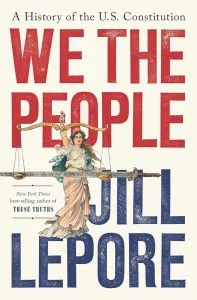
“On a chilly Saturday, December 13, 1952,” the historian Jill Lepore recounts in her new book, We the People, “the nine justices gathered in the first-floor conference room of the Supreme Court Building to begin their deliberations in Brown v. Board.”
That judicial conference would eventually produce a blockbuster decision—one that set the tone of constitutional law for generations—but many Americans might have thought the justices were missing the real action that day, which was nearby at the National Archives: “twelve police motorcycles and four soldiers carrying submachine guns, followed by a bayonet-wielding honor guard, two military bands, two armored tanks (one of which broke down en route), and thirteen hundred servicemen and women.” At the center of this display, riding in their very own tank, were the parchment copies of the Declaration of Independence and the U.S. Constitution. The documents remain on display in the National Archives today, reverently viewed by visitors, much as Mao Zedong sleeps in his tomb in Tiananmen Square.
Lepore’s lively book makes clear what should be obvious: Whatever the U.S. Constitution is, it is not that heavily guarded parchment, and not even what is written on it. Nor is it, really, the amended text after 27 post-ratification changes, the most recent in 1992. The Constitution is a protean and elusive text, not simply because it has been formally changed but perhaps even more powerfully because it has been imagined and reimagined by generations of Americans; it is a collection of sacred wisdom understood—if at all—as much by reference to truths it does not speak as by the 7,500 words it actually contains, an object of reverence, fear, and superstition, not susceptible of final and authoritative interpretation by any citizen or judge. Some generations see it as on the point of death; others see it as bursting forth renewed by flame.
No one, however, quite agrees on what it is.
Lepore—one of the most graceful, talented, and original American historians writing today—retells a story told before in books like Akhil Reed Amar’s America’s Constitution. But she tells it differently. Lepore suggests that the nature of the Constitution is to be sought not in what it says, or even what it doesn’t say, but rather in what it could say if it were changed. Change, she argues, is its enduring nature and the essence of its revolutionary spirit: “By far the most radical innovation of the U.S. Constitution, and of state constitutions, was the provision they made for their own repair and improvement by the people themselves.” Lepore thus tells the story of the Constitution not simply through the changes that have been made in it, but through the failed attempts that have been made to amend it and the complex aftereffects of those failures.
The result is generous, highly original, and consistently fascinating—de-emphasizing the stories of the so-called Founding Fathers, and the amenders, and forwarding those of ordinary people, some of whom made constitutions of their own, from the multiplicity of state constitutions to the constitutions of Native nations like the Cherokee to the people of American colonial possessions like Puerto Rico and Hawaii. We the People is also, as a matter of constitutional discourse, profoundly, indeed joyously, subversive.
The Constitution is a protean and elusive text, because it has been imagined and reimagined by generations of Americans. It is a collection of sacred wisdom understood as much by reference to truths it does not speak as by the 7,500 words it actually contains.
Lepore fires a devastating volley at the foundation of most legal scholarship and the subtopic within it called “Constitutional History”—the successful restriction of “valid” source material to an easily managed set of sources, mostly bound in matching sets of court reporters. That narrowing makes the construction of arguments within the field tidy and quick, centering the writings of long-dead judges. (Think of Justice Samuel Alito, in his savage attack on abortion rights cheerfully citing Henry de Bracton’s 13th-century De Legibus et Consuetudinibus Angliae while tiptoeing, with daintily pursed lips, past the voluminous record of American women’s actual experience over two and a half centuries.) Lepore savages the ongoing constitutional mummery that its adherents call “originalism”—the philosophy that reigns, at least when convenient, over the Supreme Court and an increasing share of the legal academy. Lepore defines “originalism” as “insistence that the only way to interpret the Constitution is to read it the way a probate judge reads a dead man’s last will and testament.”
“Originalism follows rules of evidence that no historian could accept,” she writes, quoting Robert Bork’s edict that private writings by the powerful and the powerless “count for nothing.”
“For the historian, unpublished documents written by less powerful people do not ‘count for nothing’; in fact, they count for rather a lot.”
With that, Lepore opens the door to a cornucopia of sources, characters, and stories that even the best constitutional histories often omit—documents like the 18th- and 19th-century constitutions written by Native nations; the forward-looking constitutions written by the biracial Reconstruction governments after the Civil War; Ke Kumukānāwai a me nā Kānāwai o ko Hawai’i Pae ‘Āina, the written constitution decreed by Hawaii’s King Kamehameha III in 1840, altered by his successor Kamehameha V, and forcibly replaced in 1887 by the white colonialist “Bayonet Constitution”; and La Constitución del Estado Libre Asociado de Puerto Rico, which was written for the American colony by a convention legally barred from even discussing independence and which cannot be amended without Congress’s approval.
The complex history of amendment begins even before the Constitution was ratified, because state conventions that approved the new constitution did so while loudly demanding the immediate adoption of a bill of rights. When James Madison produced a proposal for one in the First Congress, the members held a consequential debate that Lepore characterizes as “incorporationists” versus “supplementalists”; the two sides differed on how amendments should be treated. Madison wanted amendments to appear as changes to the document itself; opponents insisted that they should appear at the end of the document, leaving the original text inviolate. “The supplementalists prevailed,” she writes, “apparently because they threatened to reject the amendments if the incorporationists didn’t stand down.” Two centuries later, this mistake (and mistake it was) looms large in our history—because, among other things, the Second Amendment would seem like a different animal if it were written into Article I, Section 8, Clauses 11–16—setting out in detail the extent, and limitation, of Congress’s powers over the militia. That context would suggest to any reader that “the right of the people to keep and bear arms” also concerns the militia, not Antonin Scalia’s imaginary free-floating individual right.
A lot of dead people might be alive today if Madison had won that fight. Constitutional debates are almost always matters of life and death. (Brown v. Board, for example, did lead directly to blood on southern pavements and armed soldiers desegregating schools.)
After that beginning, We the People tells the story of the fight for amendments from 1789 to 1992. Poignantly enough, the most recent successful amendment—concerning congressional pay—was one proposed by Madison himself, which took two centuries to glean the necessary three-quarters approval of states. But the book does the signal service of making this old story new, and peopling it with characters who have been recognized only dimly, if at all, from the Founding: Sconetoyah (Cherokee), Tobocah (Choctaw), and Muckleshamingo (Chickasaw) represented Indigenous populations who knew something was up in Philadelphia (they arrived during the Constitutional Convention to ask politely for inclusion, and got none). From the Civil War era: Francis Lieber, the farsighted German immigrant who foresaw that slavery would tear the Union apart and that constitutional amendments would be needed to restore it; and Maria Henrietta Pinckney, described by her contemporaries as “a woman of masculine intellect” and a stalwart defender of slavery and constitutional nullification. From the Progressive Era: Charles Beard, whose 1913 book, An Economic Interpretation of the Constitution of the United States, pointed out that the men who drafted the Constitution had adroitly protected their own interests before anyone else’s—and became “the most influential and most controversial book ever written about the Constitution.” And from the 1950s, Ethel Payne, “five foot three, and indomitable,” who as a reporter for The Chicago Defender witnessed the oral argument in Brown and the birth of the movement to amend the Constitution to repeal the decision—and then, like a kind of journalistic Zelig, jetted off to Bandung, Indonesia, to cover the historic conference that she called “a summoning of the darker people of the world.” Payne’s story is paired with that of David Mays, the quiet lawyer from Richmond, Virginia, “a child of the Lost Cause” who devoted much of his life to advocating for the reversal of Brown, and laid the foundation for the dawn of originalism.
Most haunting to me is Lepore’s poetic invocation of Lydia Kamakaeha Lili’uokalani, the last monarch of independent Hawaii, who for the crime of seeking to restore the kingdom’s true constitution spent the last years of her reign “locked in an upstairs bedroom in the royal palace as if she were Rapunzel” and was denied any reading material, except what could be smuggled in disguised as wrapping for flowers.
We the People in outline follows the main channel of American history—the battle over federal power, then over slavery and Reconstruction, then over regulation of the economy and finally over civil rights and human equality. The book also recounts the story of successful amendments—1913, for example, brought us the elected Senate and the income tax, both adopted by overwhelming popular mobilization. She also narrates some lost ones that fit the master narrative—the proposed Thirteenth Amendment of 1861, passed by a desperate Congress and endorsed by a desperate Abraham Lincoln, which bargained the South’s remaining in the Union for a guarantee that slavery could never be outlawed. The failure of the Equal Rights Amendment, despite overwhelming support, supplies a mournful chapter. I regret the omission of some that represent digressions from the master narrative—most notably yet another lost Thirteenth Amendment, proposed by the two houses of Congress in 1810, which would have stripped citizenship from any American who accepted a noble title or pension “from any emperor, king, prince or foreign power.” (Though never ratified, this amendment was mistakenly included in a number of printed copies of the Constitution; to this day, I sometimes meet folk from the Pacific Northwest mountains who assure me that this amendment renders lawyers unconstitutional.) I wish, too, that We the People gave a fuller account of the popular mobilization that pushed the Seventeenth Amendment (popular election of senators) through a reluctant Congress, and mentioned my favorite “Founding Father,” Joseph Bristow of Kansas, who sponsored the popular-election amendment in 1911.
Originalism emerged in 1971, around the time that entrenched partisanship made formal amendment impossible. As the nation lost the will and creativity to remake the Constitution, it began to shake itself to pieces, and has reached a crisis that looks like a death agony.
The book ends with the melancholy story of the end of amendment and the rise of originalism—the replacement, in the American mind, of a “living document” with Scalia’s Constitution that is “Dead, dead, dead!” Originalism emerged in 1971, around the time that entrenched partisanship made formal amendment impossible. As the nation lost the will and creativity to remake the Constitution (for example, by abolishing the Electoral College), it began to shake itself to pieces, and has reached a crisis that looks as if it may be its death agony.
Lepore is an American, though, and optimism is the fundamental American creed. She ends the book, not in despair—“a philosophy of doom is an undemanding doctrine, and doomsday books are easy to write”—but with a call for a fundamental remaking of the Constitution not simply to democratize our policy but to include among its constituents the natural world itself:
Americans might learn again to amend, or else they could invent a new instrument to guarantee liberty, promote equality, nurture families, knit communities, thwart tyranny, and avert the destruction of a habitable earth. Constitutions began with stones and seashells, with old books and oak trees, with sheepskin and goose feathers. From the burning, scorched earth, new ideas might arise once more, seedlings, sprouting, tendrils winding to the sun.