
|
Getting your Trinity Audio player ready...
|
In the near future, a collegiate crisis is looming. Beyond the federal government’s ongoing assault on higher education, with its politicized investigations and threats to funding, an inevitable and devastating cliff awaits. We’re talking, of course, about enrollment.
As the abnormally large Millennial generation gives way to the smaller Gen Z, American colleges are losing their ability to fill seats—and balance their budgets. Between 2010 and 2021, universities lost 15 percent of their student population, or about 2.7 million people. Hundreds of schools closed. As if that weren’t enough, demographers predict that those numbers will soon plummet again, decreasing by as much as another 15 percent by 2039. Losing close to a third of their student population in total will likely mean lights out for many more schools.
There is hope, however. Even as the general population shrank, Hispanic students made up 80 percent of increases in degree attainment between 2017 and 2022. Numbers of Hispanic high school graduates are projected to increase by 16 percent by 2041. Given the existential importance of serving this population, one might think that colleges would be ferociously competing to recruit these students and get them through school, and that major education publications would be closely tracking their progress. But there are few such measures of excellence out there, and the rankings of Hispanic-serving schools that do exist mostly rely on generalized data, rather than numbers that tell you specifically how Hispanic students are doing. And that’s why this year the Washington Monthly, in collaboration with the non-profit Excelencia in Education, is releasing a comparison of how schools serve this all-important population.
The Best Colleges for Hispanic Students ranking combines the social mobility focus of the Monthly’s college rankings with the deep knowledge that Excelencia has built over decades of studying Hispanic performance in higher education. Among many other metrics, the D.C.-based non-profit gathers data on the transfer and graduation rates of Hispanic students, which are a good approximation of how well schools serve them. The hundreds of schools that apply for the organization’s “Seal of Excelencia” certification provide that information for consideration—and much more. They also submit data about diversity among faculty and staff, along with other metrics, and descriptions of their programming, communications, and long-range planning around Hispanic education. To reflect those nuanced evaluations, we tracked in our ranking whether or not a school was awarded the seal. To those metrics we added two social mobility measures from our own rankings: net price (the annual amount students pay when factoring in aid), and the percentage of students who receive Pell Grants.
We limited our ranking to federally recognized Hispanic-serving institutions (HSIs) that provided this information when they applied for the Seal of Excelencia—151 schools, out of the 615 HSIs. As a result, we’re calling this the “Best” Colleges for Hispanic Students, not “Best and Worst.” Any school that serves so many Hispanic students (the minimum for an HSI is 25 percent) and that cares enough about its performance to go through the rigorous seal application is deserving of praise.
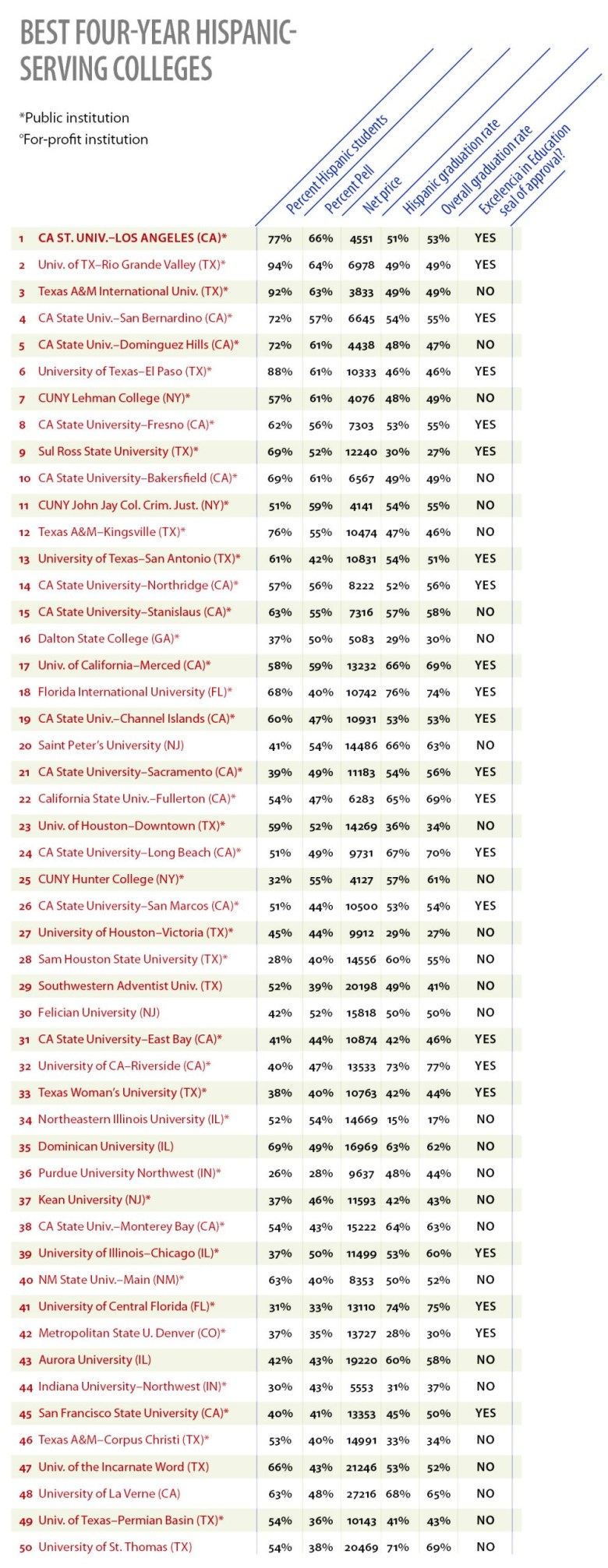
Many of the top performers, like UT–Rio Grande Valley (number two among four-year schools) and Fresno State (number eight), are favorites in the Monthly’s overall rankings (see Best Colleges for Your Tuition (and Tax) Dollars rankings). That’s no accident—those schools are already focused on delivering a quality education at low cost to underprivileged student populations. Take our number one university for Hispanic students, Cal State–Los Angeles. The regional university in East L.A. is a powerful engine of social mobility, with a low net price of $4,551 (fourth of the 1,421 schools in our overall rankings) and a high proportion of students on Pell Grants—66 percent. The school is more than three-quarters Hispanic, and it serves those students well: They graduate at close to the same rate as the general population (51 percent versus 53 percent, compared to the 13-point national gap). Cal State–LA also received the Seal of Excelencia in 2023, one of only nine institutions that year.
Patterns emerge in the rankings, especially around location. A high proportion of Hispanic college students are in California, Texas, and New York. Those states dominate the top slots here, and if the list were expanded to include the bottom two-thirds of HSIs, you might expect to see them there, too. But demographic happenstance also gives rise to intentional excellence. Eight of the top 20 schools are California State campuses, which are united by their low prices, favorable graduation rates, and high numbers of non-wealthy students. The University of Texas and Texas A&M systems also do well. Texas A&M International is in third place, with an incredibly low price of $3,833 and a graduation rate for Hispanic students equal to that of the general population. Five other Texas schools occupy the top 20, including little-known Sul Ross State University (nine), a Seal of Excelencia winner that graduates Hispanic students at a better rate than it does the general population. The same is true of UT–San Antonio (13), which also boasts a seal, 42 percent Pell enrollment, and reasonably low costs.
You might think that colleges would be ferociously competing to recruit Hispanic students, the one segment of the market that’s growing, and that major education publications would be closely tracking their progress. But there are few such measures of excellence out there, and the rankings of Hispanic-serving schools that do exist rely on generalized data, rather than numbers that tell you specifically how Hispanic students are doing.
The rest of the country has plenty to offer, too. A few Florida schools, including Florida International University (18), reach the upper echelons. Like California and New York, much of the Florida state system’s excellence in our rankings is owed to a unified governance structure whose focus on affordability keeps tuition low. (See Christopher M. Mullin, “Florida’s Fresh-Squeezed Colleges.”) In Georgia, Dalton State College rises to 16th place mostly by virtue of its attractive cost—$5,083 a year. (The graduation rates, though not great, are about equal between Hispanic students and the general population of the college.) Two CUNY branches, Lehman and John Jay, make the top 20. Just a few miles apart and roughly the same size, they offer very low costs—around $4,000—to their roughly half-Hispanic student populations, and have virtually no ethnic graduation gap. John Jay proudly features a wide array of student support resources, including ¡Adelante!, a two-year leadership program that provides academic mentorship, career advice, and financial support to Hispanic students.
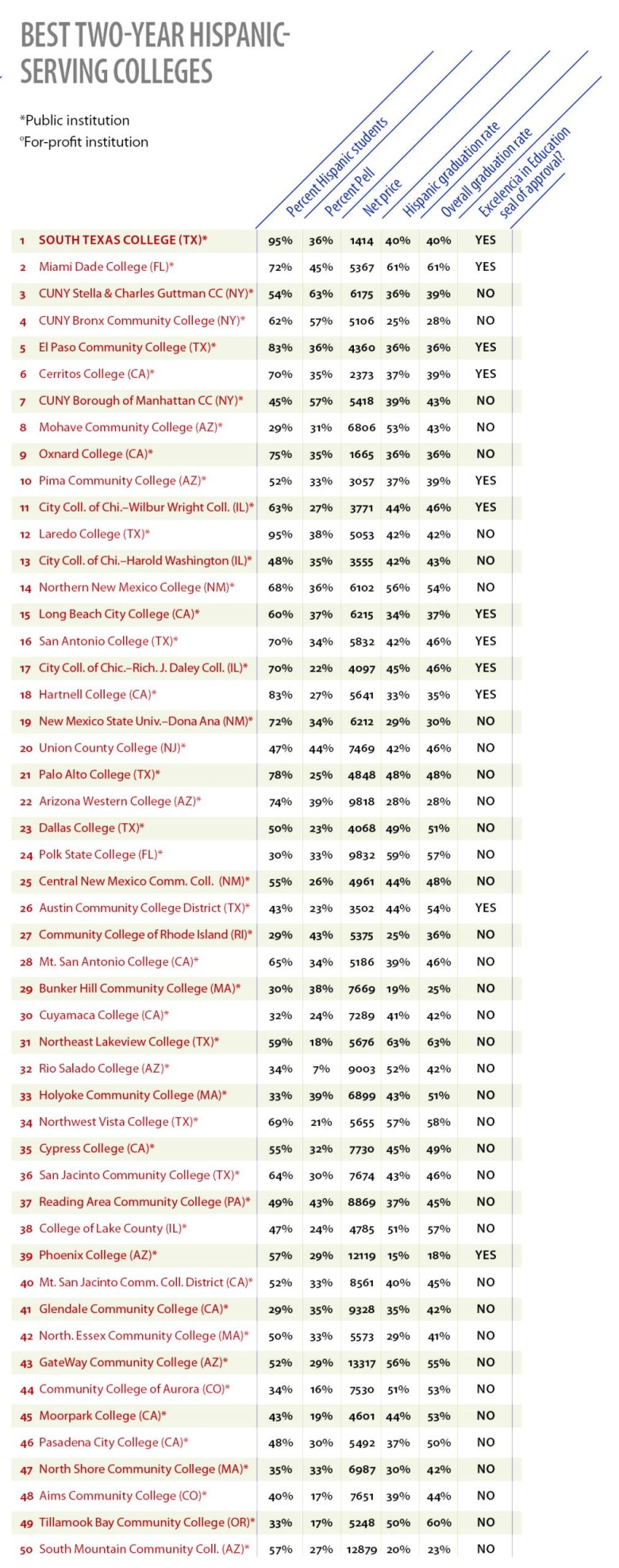
We also rank two-year schools in a separate list, because of a methodological wrinkle: Given how often students at these institutions finish their degrees at other schools, we count transfers as a positive rather than a negative. The number one performer is South Texas College, a community college in the Rio Grande Valley with an overwhelmingly Hispanic student body—95 percent. Students pay a staggeringly low $1,414 a year, net of aid, and more than a third are on Pell Grants. In 2022, South Texas College celebrated its high performance in a ranking from Excelencia of schools that enroll and graduate Latinos. “Being an HSI is more than just a designation for STC, it’s our identity; it’s who we are,” Matthew Hebbard, vice president of student affairs and enrollment management, said in a statement. The school focuses heavily on student support services for its many first-generation and ESL students, as well as on hands-on vocational training, including at partner universities in Mexico that prepare students for manufacturing jobs.
These schools offer many concrete lessons about the kinds of programs that best serve Hispanic students. Crucially, they aren’t limited to one part of college. Our number two four-year school, UT–Rio Grande Valley, boasts a comprehensive strategy that includes “Tuition Advantage,” a program that pays tuition and fees for students with family incomes under $125,000; a dual credit program with several area high schools; and a robust international student services department for its Latin American undergraduates. One of Excelencia in Education’s regular awards is the “Examples of Excelencia,” four programs chosen from dozens around the country as a model for what works. They include a wide range of programs, from student support services to language instruction to academic skills classes to scholarships and recruiting initiatives meant to boost access to college.
Eight of the top 20 schools are California State campuses, which are united by their low prices, favorable graduation rates, and high numbers of nonwealthy students. The University of Texas and Texas A&M systems also do well. Texas A&M International is in third place, with an incredibly low price of $3,833 and a graduation rate for Hispanic students equal to that of the general population.
There are many places to find great ideas, including at schools that aren’t on this list. In 2024, one of the finalists for the Examples of Excelencia award was a student support service at Santa Barbara City College called the Writing Center, which works with high numbers of Hispanic students. Just creating a student service center focused on writing support isn’t the innovation; what’s special about the Writing Center, Emma Trelles, the poet and former professor who directs the center, told me, is the staff’s understanding of how cultural and linguistic understanding affects success. “As the daughter of immigrants and the first in my family to complete college and go on to get a master’s, I know firsthand how hard it is to navigate bureaucracies and complete platforms and all the things you have to do as a student when you don’t have guidance,” she told me. The center’s handpicked tutors, about a third of whom are bilingual in English and Spanish, view themselves as “collaborators,” Trelles said, not teachers or lecturers. Some students come for just a few sessions—like a young man of Mexican descent who recently asked Trelles for help navigating the college online dashboard. Others come back again and again, brushing up on their writing, polishing their English, and sometimes just talking through their daily problems and fears. In applying for the Examples of Excelencia award, the Writing Center tracked down statistics on its own effectiveness. From 2017 to 2023, Hispanic students who visited the center between one and three times completed their classes at rates 13 to 25 percent higher than those who didn’t visit at all.
Completion, and enrollment—colleges will need to improve their performance in these areas over the coming decade if they wish to survive. And to do so, they will need to serve an expanding and often under-privileged student population that itself is a focus of many of today’s political attacks. (On his first day in office, Donald Trump rescinded Biden-era initiatives to support HSIs as part of a slew of executive orders against what he called “harmful” DEI.) By highlighting the schools that have recognized and accepted that mantle, we hope to inspire others to follow. Maybe then that cliff will not seem so steep.
Best Hispanic-Serving Colleges (4yr and 2yr)